Key takeaways
- NQA-1 is ASME's quality assurance standard for nuclear facility work. It is built on the 18 criteria of 10 CFR 50 Appendix B and endorsed by the NRC in Regulatory Guide 1.28.
- The standard is layered: mandatory requirements, requirements for specific applications that apply when invoked, and nonmandatory guidance that shows acceptable ways to comply.
- Qualification normally comes through your customer: an owner, prime or DOE audit of your QA program. ASME Section III certificate holders must also run an NQA-1-based program.
- A single field weld triggers WPS verification, a welder qualification check, a weld log entry, a weld map update, NDE records and possibly a nonconformance report.
- The cost of NQA-1 work is mostly documentation labor, and it scales with weld volume and how much of your QC work is still on paper.
NQA-1 is ASME's quality assurance standard for nuclear facility work, built on the 18 criteria of 10 CFR 50 Appendix B and applied to your scope by contract. If you weld, fit or inspect piping on DOE or commercial nuclear jobs, NQA-1 governs how you control and document that work. This guide explains the structure and traces one field weld through the requirements it touches.
What is ASME NQA-1?
ASME NQA-1, Quality Assurance Requirements for Nuclear Facility Applications, sets the requirements an organization must meet to show that safety-related structures, systems and components were built under a controlled, documented QA program.
For a piping contractor, NQA-1 governs the QA side of the work: procurement, control of special processes such as welding and NDE, inspection, nonconformances and records traceable from the isometric to the weld log. ASME Section IX tells you how to qualify a WPS and a welder. NQA-1 tells you how to control those documents, records and people so a DOE or NRC reviewer can verify the work years later.
Who needs to comply with NQA-1?
NQA-1 applies to organizations supplying safety-related structures, systems and components for nuclear facilities: fabricators, piping and mechanical contractors, material suppliers and inspection agencies. If your welds end up in a safety-class system, your QA program has to meet it, either directly or through the program of the prime you work under.
NQA-1 vs. 10 CFR 50 Appendix B on commercial nuclear work
10 CFR 50 Appendix B is the regulation; NQA-1 is the ASME standard that shows how to satisfy it. The NRC endorses NQA-1 in Regulatory Guide 1.28, so most commercial nuclear suppliers build their Appendix B program on NQA-1 instead of writing criteria from scratch. Audit findings are typically written against NQA-1 requirement numbers.
When DOE work pulls you into NQA-1
DOE nuclear facilities fall under the quality assurance rule in 10 CFR 830 Subpart A, and DOE Order 414.1 sets quality assurance requirements across DOE work. Both point contractors to NQA-1 as the consensus standard for nuclear work. DOE applies a graded approach, so the safety classification of each system dictates how much of NQA-1 applies to your weld program. Confirm which requirements and which edition your contract invokes before you bid.
How is the NQA-1 standard structured?
NQA-1 is organized in layers. Each layer extends the one above it, and your contract and QA manual decide which apply.
Requirements (Part I)
Part I holds the 18 requirements, adapted from the 18 criteria of 10 CFR 50 Appendix B. They cover the full QA lifecycle: organization, the QA program itself, design control, procurement, document control, special processes, inspection, test control, nonconformances, corrective action, records and audits.
Supplementary requirements
Several requirements carry supplements that add mandatory detail where the work demands it. Supplement 9S-1, for example, adds detail on controlling special processes such as welding, heat treating and NDE, and Supplement 2S-1 covers the qualification of inspection and test personnel.
Requirements for specific applications and nonmandatory guidance
Later parts of the standard add requirements for specific applications that apply when your contract invokes them, plus nonmandatory appendices and guidance. The nonmandatory material shows one acceptable way to meet a requirement, and contractors often adopt it as the basis for their own procedures.
Which parts are mandatory and which are optional
| Layer | Status | Example |
|---|---|---|
| Part I requirements | Mandatory once invoked | Requirement 6, Document Control |
| Supplements | Mandatory when they apply | 2S-1, inspection and test personnel qualification |
| Nonmandatory appendices and guidance | Guidance only | Sample implementation methods |
Your QA manual states which requirements apply to which structures, systems and components, and that commitment becomes auditable.
What are the 18 requirements in NQA-1?
NQA-1 Part I, Requirements 1 through 18:
| # | Requirement | # | Requirement |
|---|---|---|---|
| 1 | Organization | 10 | Inspection |
| 2 | Quality Assurance Program | 11 | Test Control |
| 3 | Design Control | 12 | Control of Measuring and Test Equipment |
| 4 | Procurement Document Control | 13 | Handling, Storage, and Shipping |
| 5 | Instructions, Procedures, and Drawings | 14 | Inspection, Test, and Operating Status |
| 6 | Document Control | 15 | Control of Nonconforming Items |
| 7 | Control of Purchased Items and Services | 16 | Corrective Action |
| 8 | Identification and Control of Items | 17 | Quality Assurance Records |
| 9 | Control of Special Processes | 18 | Audits |
Every requirement can apply to a nuclear or DOE piping job. The difference is how much of your daily QC work each one touches.
The requirements that hit piping contractors hardest
Design control (Requirement 3) and document control (Requirement 6) govern how you handle isometrics, spool drawings and WPS/PQR revisions in the field. Procurement document control (Requirement 4), control of purchased items (Requirement 7) and identification and control of items (Requirement 8) follow material and heat numbers from the supplier into the weld. Control of special processes (Requirement 9) covers welding, PWHT and NDE. Inspection (Requirement 10) and test control (Requirement 11) drive hold points, NDE records and pressure tests.
Control of nonconforming items (Requirement 15) is where most audits dig in: every rejected weld needs a disposition, a traceable record and a link back to the original weld map.
How the 18 map to your QA manual
Your QA manual should address each requirement by number, with a procedure cited for each. Auditors walk the manual against the field: pick a weld and trace it from the iso to the welder's qualification (WPQ) to the NDE report to the nonconformance file if it failed. If that trace requires pulling paper from three binders, the manual is compliant on paper but fails in practice.
How does NQA-1 relate to ISO 9001 and Appendix B?
Why ISO 9001 certification does not get you nuclear work
ISO 9001 and NQA-1 share a common skeleton: documented procedures, corrective action, records control and audits. But ISO 9001 lets each organization decide how much rigor to apply, while NQA-1 fixes the rigor for safety-related work. It also adds requirements ISO 9001 has no direct equivalent for, such as commercial grade dedication and formal qualification of the people and procedures behind special processes. A nuclear buyer will not accept an ISO 9001 certificate in place of an NQA-1 program.
Appendix B as the regulatory root
10 CFR 50 Appendix B is the regulation that created nuclear QA, and NQA-1 translates its 18 criteria into practice. DOE contractors work under the parallel 10 CFR 830 and DOE O 414.1 requirements, which also point to NQA-1. The hierarchy runs from Appendix B or the DOE rules, down to NQA-1, down to your procedures.
What does NQA-1 compliance look like in day-to-day QA work?
Fit-up and WPS verification (Requirements 5, 9 and 10)
A fitter calls fit-up complete on a 6-inch Schedule 80 butt weld. Before an arc is struck, the joint is checked against the WPS: base metal P-numbers, filler specification, preheat. Requirement 5 says the work must be performed to documented instructions and procedures. Requirement 9 says special processes like welding must use qualified procedures and qualified personnel per the applicable code, typically ASME Section IX, so the inspector confirms the welder's WPQ and continuity before the weld starts. Requirement 10 makes that fit-up check a documented inspection, not a memory.
Weld map and traceability records (Requirements 8 and 17)
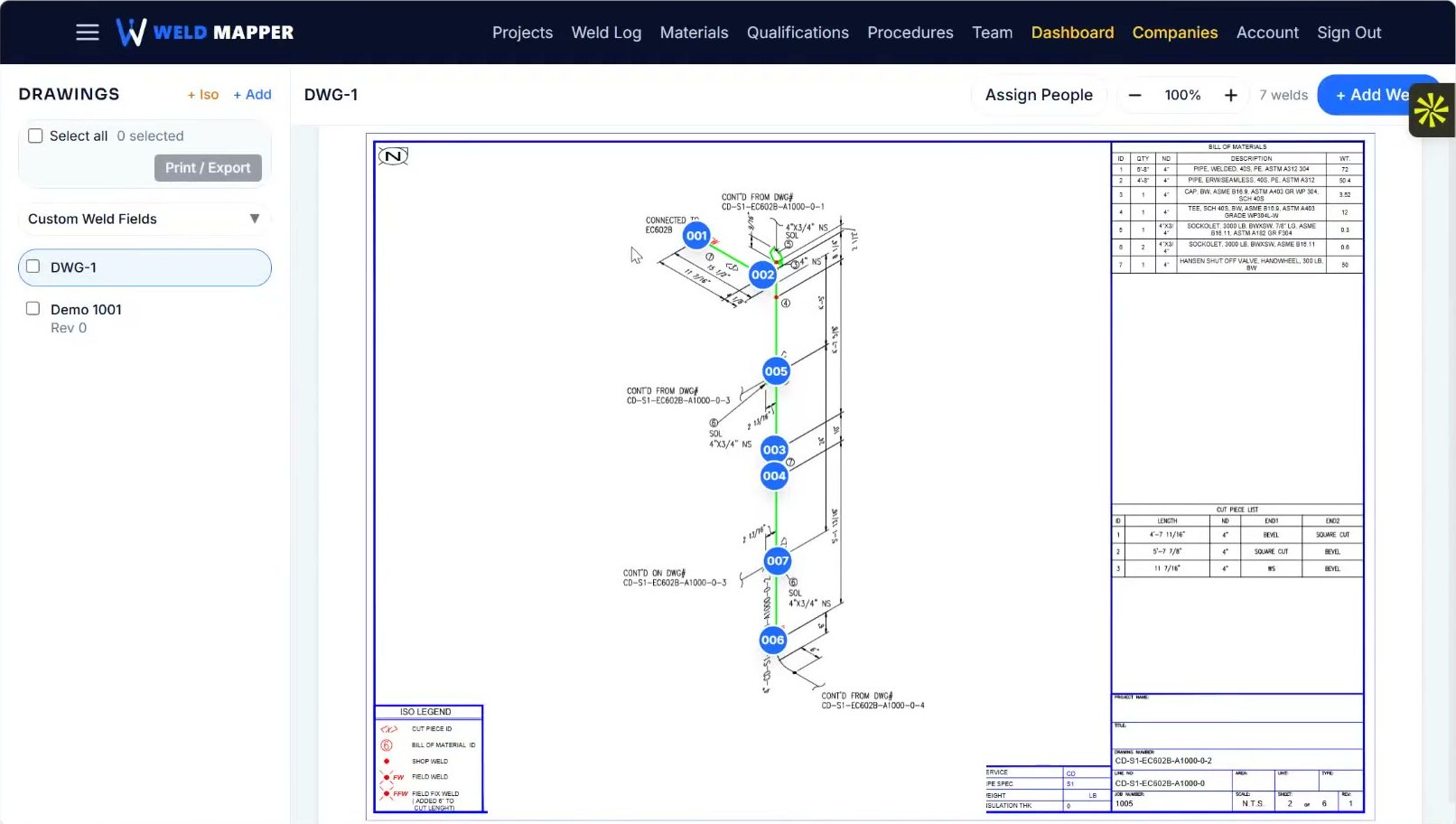
A weld map in WeldMapper. Each numbered pin carries the weld ID that the weld log, NDE report and repair records point back to.
After the weld is made, it carries a unique ID tied to the iso drawing and spool number. Requirement 8 keeps the item identified and traceable, and Requirement 17 drives the records: weld log entry, filler heat number, welder ID, date and location on the weld map. On a DOE job, that weld may need to be traceable decades later, so the record has to survive personnel turnover and archive migrations.
NDE results and nonconformance handling (Requirements 9, 12, 15 and 16)
The NDE itself is a special process under Requirement 9, performed by qualified personnel to qualified procedures, with equipment controlled under Requirement 12. If RT shows slag, Requirement 15 kicks in: the nonconformance gets documented, dispositioned and repaired under a controlled procedure. If the same defect keeps showing up, Requirement 16 requires corrective action on the cause. The repair weld repeats the whole loop.
Where the documentation hours actually go
The welding takes an hour. The paper trail around it is where contractors lose days. Each weld triggers a WPS verification, a welder qualification check, a weld log entry, a weld map update, an NDE record and possibly a nonconformance report. Multiply that by hundreds of welds per project and the documentation burden becomes a staffing question, not a paperwork nuisance.
Most QC managers running NQA-1 work find that the records themselves are not hard to produce. The problem is producing them consistently, legibly and retrievably when every entry was handwritten in the field and retyped in the office. That transcription step is where hours vanish and where transposition errors creep in. Whether you manage it with spreadsheets or a dedicated tool like WeldMapper, the requirement is the same: records that are identifiable, legible and retrievable when the audit comes.
How do you get NQA-1 qualified?
For most piping contractors, there is no certificate to buy. Your NQA-1 standing comes from having your QA program audited and accepted by the customer you supply.
ASME Section III certificates
ASME accredits manufacturers and installers of nuclear components through its Section III certificate programs, such as the N, NPT and NA certificates. Holding one requires an approved QA program that meets NQA-1. If your scope is field welding on a DOE or owner contract rather than Code-stamped components, your qualification usually comes from the customer's audit instead.
What an owner or DOE audit of your QA program looks for
Auditors trace a weld from the iso through the weld log, WPS/PQR records, NDE reports and PWHT charts to the final turnover package. They check that your procedures implement the applicable requirements and that field practice matches what the procedures say. Gaps between the written process and actual practice are the most common findings, which is why weld traceability records get sampled first.
What does NQA-1 documentation cost a piping contractor?
The cost is mostly labor: QC hours spent building weld logs, marking up isos and assembling turnover packages. It scales with weld volume, crew count and how much of your QA/QC work is still on paper. You can estimate yours with the WeldMapper ROI calculator.
Where the hours go: weld logs, isometric markups, NDE packages
Weld logs get rebuilt by hand from field notes. Isometrics get marked up, scanned and re-marked when a weld moves. NDE packages get assembled weld by weld before turnover, and every gap sends an inspector back to the field. On a nuclear job, a missing WPQ reference or PWHT record can hold a turnover package for days.
What changes when records are captured in the field
When welders and inspectors record welds against the iso at the point of work, the weld map builds itself and the links to the WPS, PQR and NDE results stay attached. Turnover packages assemble from records that already exist instead of being reconstructed. The hours saved come from eliminating re-entry and package rework, not from skipping any NQA-1 requirement. Book a walkthrough to see it on one of your own isos.
FAQ
Is NQA-1 mandatory or just guidance?
NQA-1 is a voluntary consensus standard until a contract or regulation invokes it. The NRC endorses it in Regulatory Guide 1.28 as a way to satisfy 10 CFR 50 Appendix B, and DOE's quality assurance requirements point to it for nuclear work. Once your contract cites it, the invoked requirements become mandatory and auditable.
What is the current edition of ASME NQA-1?
ASME revises NQA-1 periodically, and the edition that applies to you is usually fixed by the contract or the regulator's endorsement, not by whatever is newest. Confirm which edition your customer's contract specifies before writing or revising procedures, because requirements can shift between editions.
Can a subcontractor work under the prime's NQA-1 program, or does it need its own?
It depends on how the prime structures the work. A prime can flow NQA-1 requirements down and control your work through its own program, audits and inspections. Many primes, though, require subcontractors to hold their own Appendix B-compliant program, especially for safety-related welds. The procurement documents define whether you work under their program or yours.
How long does it take to build an NQA-1 QA program from scratch?
Plan on months, not weeks. You need a QA manual addressing the applicable requirements, procedures for each, trained personnel and a records system, then an audit before work starts. Contractors with an existing ISO 9001 or commercial QC program get there faster, but field practice has to match the written procedures before an owner or DOE audit.
Does NQA-1 apply only to safety-related piping, or also to non-safety work?
NQA-1 targets safety-related structures, systems and components, but non-safety work on the same project often picks up some of its requirements. DOE contracts use a graded approach, so the safety classification of each system dictates how much of the standard applies. Your contract and QA manual define which requirements cover non-safety scope.
Sources
- ASME NQA-1, Quality Assurance Requirements for Nuclear Facility Applications (ASME)
- 10 CFR Part 50, Appendix B: Quality Assurance Criteria for Nuclear Power Plants and Fuel Reprocessing Plants (Code of Federal Regulations, GovInfo)
- 10 CFR Part 830, Subpart A: Quality Assurance Requirements (Code of Federal Regulations)
- DOE O 414.1E, Quality Assurance (U.S. Department of Energy)
See WeldMapper on your own drawings
Bring an iso from a current job. We'll map it live in a 15-minute walkthrough.